Lucy Catchpole
January and February just DID NOT EXIST in early Roman calendars. So what did they do about the time of the year we know as January and February? It was basically just blocked out and marked “winter”. Which says it all, really.


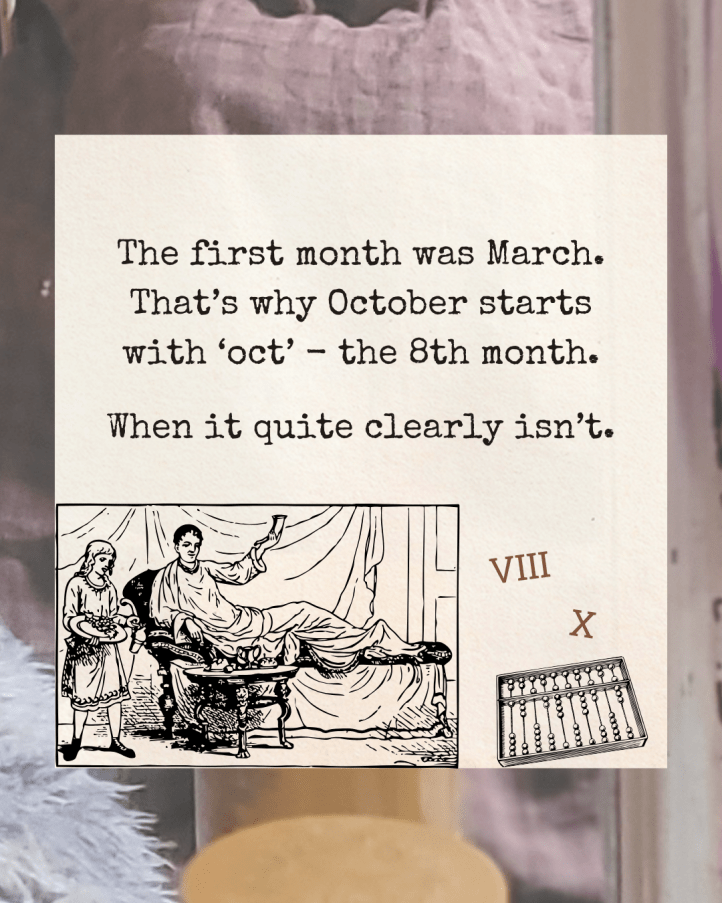




Fighting the calendar is becoming a bit of a niche hobby of mine – and this time, I think the Romans had a point. Initially the first month was March, which makes so much sense. Imagine, it’s spring – new life, new year. The theory is that calendars are for planning – farming and festivals. And neither were going to happen once December was done. The hardcore of winter was about surviving.
I’ve often wondered why October starts with ‘oct’ despite clearly being the tenth month – and now I know. Oct means eight, like in octagon, octopus, octuplets. The eighth month. But it quite clearly isn’t the eighth month, is it? And September isn’t the seventh even though it starts with ‘sept’, November isn’t the ninth, December isn’t the tenth – you get the idea.
When January and February were invented and shoved in before March, the rest of the months just shifted along – leaving the now anachronistic names. The names for September, October, November and December haven’t made any sense for thousands of years. Why haven’t we changed it? I have no idea.
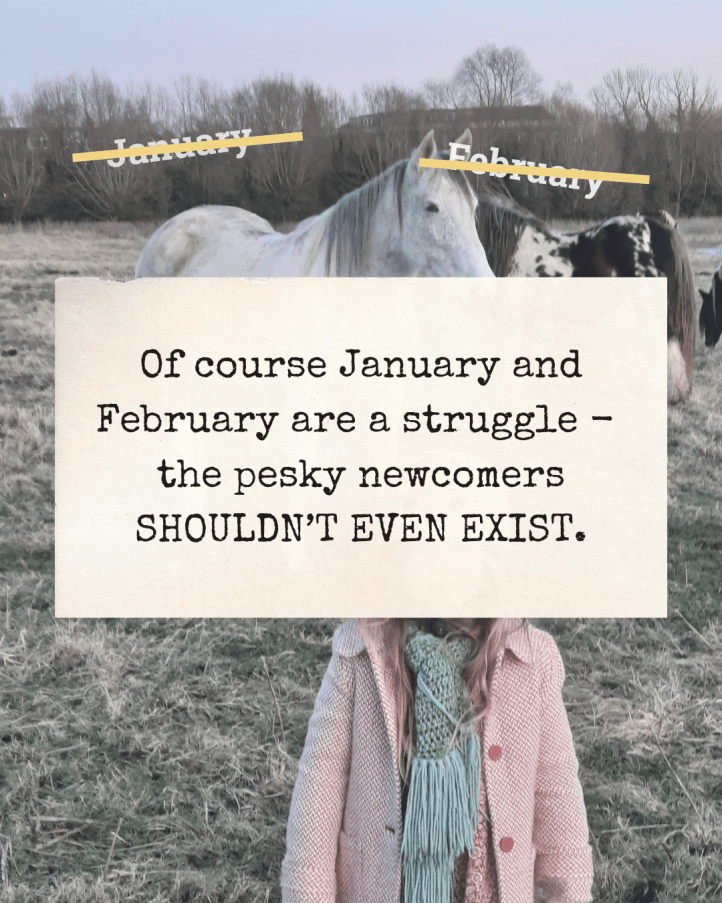
Anyway, as far ass I’m concerned this explains everything. Of course, even today, January and February are a struggle – the pesky newcomers shouldn’t even exist.
January seems to have become the beginning of the year around 153 BCE. (Maybe the calendar should cover all the year? And start in winter? – some Romans thought. Ridiculously.) There’s confusion about who made that call. The first sources I found pinned it on Julius Caesar, and I initially went with that (though, honestly, it seemed a bit too good to be true – what were the chances it’s down to the one Roman everyone’s heard of?). It may have been Numa Pompilius1 who got rid of the ten month calendar, around 700 BCE, but then again – he may be fictional2. The mysterious joys of ancient history. (Which is not my subject – in case that weren’t blindingly obvious.)

Not quite a mead hall – a still from Wolf Hall, the closest I could get
To further complicate things, this new winter beginning took centuries to truly bed in across the world. Presumably precisely because it makes so little sense to start the year in the depths of winter. In England, we still celebrated New Year’s Day on March 25th until 17523 – when Great Britain and its American colonies finally switched. Those centuries in between must have been logistically interesting.
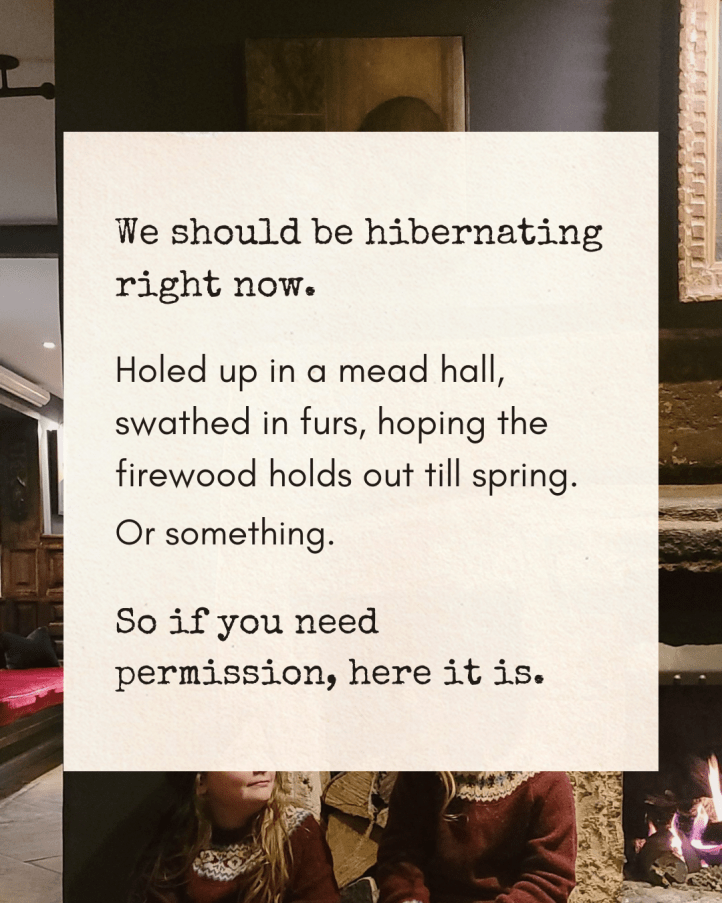
If you ask me, we should be hibernating right now. Holed up in a mead hall, swathed in furs, hoping the firewood holds out till spring. Or something. So if you need permission, here it is. Join me – boycott winter.

On a more personal note, I was talking to my 6 year old about rest – my disability means I need a lot of it. It’s frustrating, of course it is. For me and my children. We talked through the pattern of the year – that I rest now after Christmas, and it’s long, but I’m waiting for spring. (And this year, I sincerely hope I won’t be pushed wildly off-course by any unexpected fractures. 2024 was a lot.)

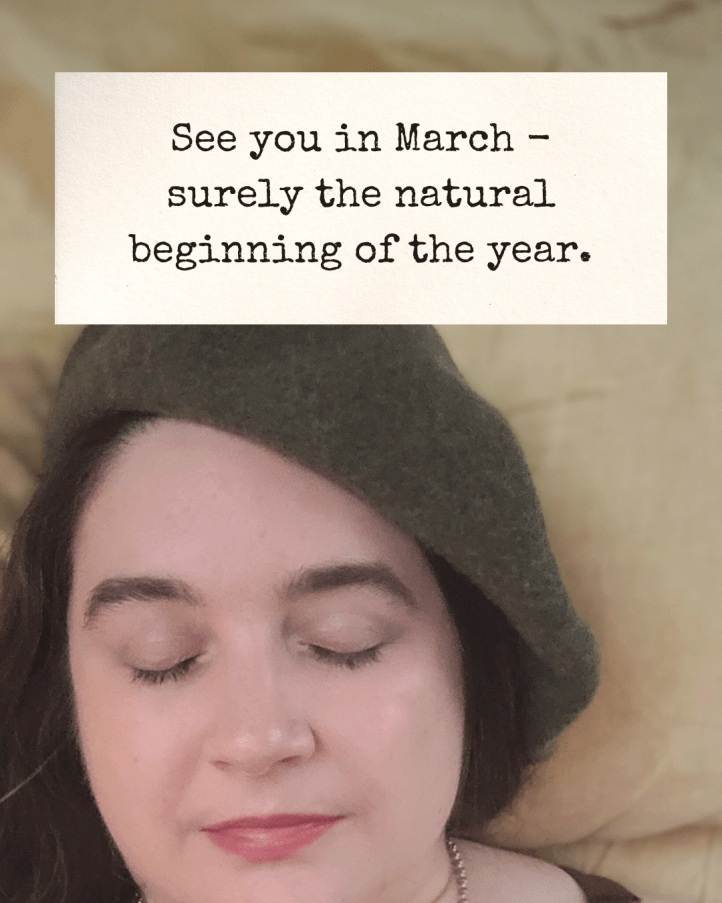
It made sense to her, and now she wants a March party. Spring is a far better time to think about new beginnings, surely. Nature really pushes us in that direction. And all those new year reflections and resolutions can surely wait till then.
🌱 Spring will come – and we will celebrate.
~Lucy Catchpole
[Image descriptions
Slideshow:
- Over a mirror selfie, text reads: “February LITERALLY DIDN’T EXIST in early Roman calendars.”
I’m a woman with long dark hair sitting in my wheelchair, looking down. I’m wearing a brown beret, a mustard top and a brown linen skirt. You can see the frame of the mirror. Text – and on all subsequent images – is written in a typewriter font, on a cream paper note in the foreground. - A very similar image, taken a second later. Text reads:
“AND NEITHER DID JANUARY”. - “So what, you ask, did they do about January and February?
They were basically just blocked out & marked “winter”.
Which says it all if you ask me.”
The cream paper is larger than previous images. The months of January and February are crossed out and the word “winter” has a tick next to it.
The photo behind is a a snowy winter scene, just visible at the top and bottom. - “The first month was March.
That’s why October starts with ‘oct’ – the 8th month.
When it quite clearly isn’t.”
A close-up of my skirt behind. The image on the cream paper includes two illustrations – two Roman men, one reclining on a couch, and a traditional abacus, a tool used for counting. The abacus is labeled with Roman numerals VIII and X, showing the numerical inconsistency of the month names. - “Calendars are for planning – farming and festivals.
None of that was going
to happen after December –
winter was about surviving.”
Photo behind is from the same series – close-up, half of my face visible, this time I’m looking at the camera. - “Of course January and February are a struggle –
the pesky newcomers SHOULDN’T EVEN EXIST.”
Full outdoor shot – quote overlaid on a frosty winter landscape with horses in the background.
The words “January” and “February” written above them in cream text.
Viola is just visible in the wintry photo behind, wearing a coat and elegant green hand-knitted scarf. - “January only became the beginning of the year around 153 BCE.
A ridiculous decision.”
Below, a speech bubble coming from an illustration of a Roman on the right contains the question:
“Maybe the calendar should cover all the year?
And start in winter?”
On the left, illustration of Roman women lounging. Speech bubbles say: “Spoilsport”, and “Why – WHY?”. - “We should be hibernating right now.
Holed up in a mead hall, swathed in furs, hoping the firewood holds out till spring. Or something.
So if you need permission, here it is.”
The background photo is slightly out of focus, you can see a dark-toned wall, a fireplace with a log fire, and a part of a red upholstered bench. A small portion of the girls in winter jumpers are visible in the background. A cosy, wintry atmosphere. - “See you in March –
surely the natural beginning of the year”
Photo behind is a close-up of the upper part of my face – I’m lying down, wearing my beret, my head on the pillow with my eyes closed. - “Spring will come – it always does.
Isn’t spring a better time for all the new beginning stuff?
Nature seems really, really keen on that idea.”
The background image shows a sweep of snowdrops emerging from a woodland floor. Bare, leafless trees form the backdrop. - “Let’s boycott winter like it’s 46 BCE.”
Image behind is another variant on the original image of me in the mirror.] many Tim-on-father’s-shoulder images we’ve seen – he holds up his crutch. But it’s somehow less annoying when Tim’s a puppet.
Other images:
- “So what, you ask, did they do about January and February?
- They were basically just blocked out & marked “winter”.
- Which says it all if you ask me.”
- The cream paper is larger than previous images. The months of January and February are crossed out and the word “winter” has a tick next to it.
- “Of course January and February are a struggle –
the pesky newcomers SHOULDN’T EVEN EXIST.”
Full outdoor shot – quote overlaid on a frosty winter landscape with horses in the background.
The words “January” and “February” written above them in cream text.
Viola is just visible in the wintry photo behind, wearing a coat and elegant green hand-knitted scarf. - A still from Wolf Hall – Cromwell’s wife sits by candlelight. Set in the Tudor period, it’s dark and a bit cosy.
- “Spring will come – it always does. Isn’t spring a better time for all the new beginning stuff? Nature seems really, really keen on that idea.” The background image shows a sweep of snowdrops emerging from a woodland floor. Bare, leafless trees form the backdrop.
- ‘February LITERALLY DIDN’T EXIST in early Roman calendars’.]

 The Catchpoles